Depth Drives Vision: How Jiatel Solves the 4 Core Pain Points in Machine Vision
Introduction: From ‘Seeing’ to ‘Understanding’ – The Inevitable Shift to 3D Vision
In the era of Industry 4.0 and advanced AI, machine vision capabilities must evolve beyond simple two-dimensional (2D) image recognition. Whether it’s for robotic bin picking, Automated Guided Vehicle (AGV) navigation, or high-precision industrial inspection, systems require crucial three-dimensional spatial data—depth information.
However, the transition from merely “seeing” an object’s color to “understanding” its spatial structure presents significant challenges. Environmental light interference, low-textured surfaces, the trade-off between cost and precision, and complex integration hurdles often stall 3D vision projects.
The Jiatel Depth Camera is engineered precisely to address these pain points. Utilizing cutting-edge Active Stereo Vision Technology, we offer a high-precision, stable, and highly compatible 3D intelligent solution for global developers and integrators in machine vision and robotics.
The Four Critical Pain Points in Modern Machine Vision
Engineers and integrators integrating 3D depth cameras into real-world applications commonly encounter the following four major obstacles:
1. The ‘Blind Spot’ Dilemma: Missing Texture and Ambient Light Interference
Traditional passive stereo cameras rely on natural texture on object surfaces to find matching features and calculate depth. This approach fails in practical industrial settings:
-
Low-Texture Objects: Smooth metallic parts, white plastics, or plain cardboard boxes lack sufficient texture, resulting in sparse or broken depth maps—the notorious “blind spots.”
-
Strong Ambient Light: Direct sunlight or inconsistent factory lighting severely interferes with Infrared (IR) sensing, causing unstable and inaccurate depth readings.
2. The ‘Impossible Triangle’: Precision, Cost, and Integration Complexity
The current market struggles to balance three critical factors:
-
High Precision, High Cost: Devices capable of industrial-grade (sub-millimeter) precision, such as high-end laser scanners, are often prohibitively expensive for widespread deployment.
-
Low Cost, Low Reliability: Affordable, consumer-grade sensors often fail to meet the industrial demands for accuracy and long-term stability.
-
Integration Headaches: Many depth camera SDKs are closed or offer poor cross-platform compatibility, particularly with embedded systems like Linux and Raspberry Pi, significantly increasing integration time and costs.
3. The Challenge of Real-Time Performance and Long-Term Stability
For applications like robotic grasping or high-speed quality control, depth data must be acquired and processed in real-time and at high speeds.
-
Data Bottleneck: High-resolution depth and RGB data generate massive streams. Conventional USB 2.0 cannot sustain the required high frame rates (e.g., 30 FPS).
-
Thermal Drift: Long-term operation in industrial environments causes temperature fluctuations, which can physically alter optical components. This necessitates an often missing thermal compensation mechanism to prevent frequent depth recalibration.
4. The Last Mile: Turning Point Clouds into Actionable Decisions
Acquiring accurate point cloud data is only the first step. Translating this raw data into robot executable grasp poses, inspection results, or navigation commands requires powerful, application-specific algorithms. Many hardware vendors offer raw data but lack the necessary algorithm support and secondary development assistance.
Jiatel– Deep Dive into Active Stereo Vision
The Jiatel Depth Camera confronts these challenges head-on using its specialized Active Stereo Vision architecture.
1. Core Principle: Active Projection for Texture Agnosticism
The core strength of the [Your Product Name] lies in its ability to actively enhance the scene:
-
IR Speckle Projection System: A built-in high-power IR VCSEL projector casts millions of non-repeating, invisible random speckles onto the environment.
-
Artificial Feature Creation: Regardless of whether the object has natural texture, the projector artificially creates a high-density layer of unique feature points on its surface.
-
Stereo Calculation: Dual Global Shutter IR cameras simultaneously capture the scene with the projected pattern. The vision processor calculates the disparity between these artificial features using triangulation to determine the precise depth.
[Key Value] Breaking the Texture Barrier: This mechanism fundamentally eliminates the “blind spot” issue prevalent in low-texture environments, ensuring the depth map is consistently dense and complete.
2. High-Speed Reliability: USB 3.0 and UVC Standardization
To meet real-time industrial demands, the [Your Product Name] features a superior data transfer solution:
-
USB 3.0 (SuperSpeed): Provides the massive bandwidth (up to 5Gbps) necessary to reliably stream 4K (3840×2160) RGB video and High-Definition Depth Maps at full frame rates (e.g., 30 FPS), eliminating data bottlenecks.
-
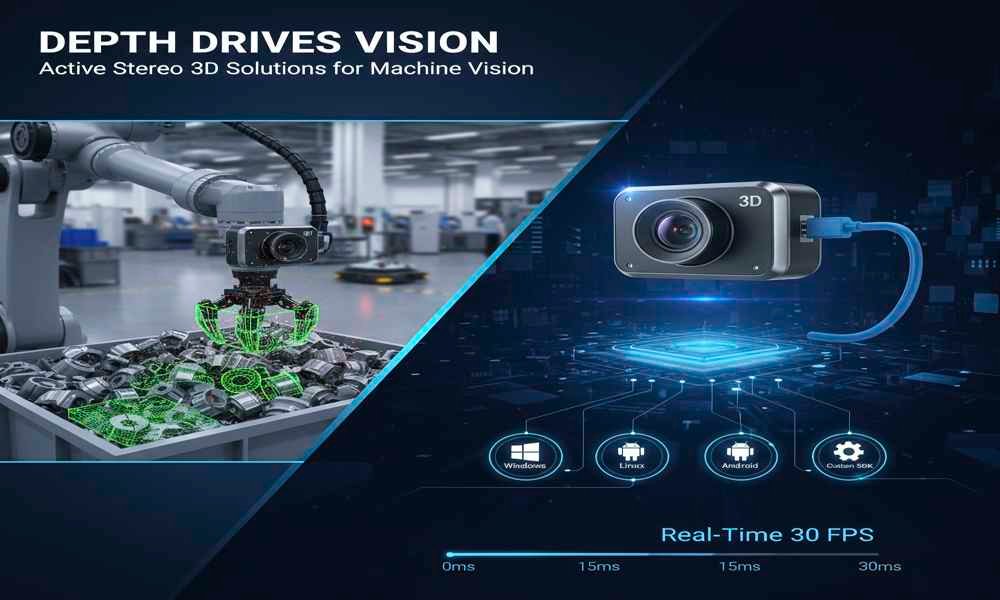
Standard UVC (USB Video Class) Protocol: Adhering to this industry standard ensures driver-free, plug-and-play functionality. It guarantees seamless compatibility with Windows, Linux, Android, macOS, and even embedded platforms like Raspberry Pi/NVIDIA Jetson.
3. Fusing 3D with 2D Excellence: 8MP Large Target RGB Sensor
We integrate a high-specification 2D module to support applications requiring combined 2D identification and 3D measurement:
-
8 Megapixel (4K) Resolution: Delivers ultra-clear color images for applications like facial recognition and detailed inspection.
-
1/1.8″ Large Target Size: Ensures superior light sensitivity. Coupled with optimized ISP algorithms, this allows for Starlight Night Vision performance, guaranteeing high-quality RGB images even in dark or complex lighting conditions.
Disruptive Solutions: Overcoming the Final Industrial Hurdles
The Jiatel provides tangible application value by addressing the pain points head-on:
1. Superior Precision and Long-Term Stability
We understand that industrial projects demand unwavering precision.
-
Industrial-Grade Precision: Factory-calibrated to deliver reliable depth measurement accuracy, meeting the stringent requirements for quality control and precise grasping tasks.
-
Integrated Thermal Compensation: Addressing the thermal drift issue, the [Your Product Name] includes built-in temperature sensors and calibration algorithms that compensate for temperature changes in real-time. This ensures the depth data remains stable over long operation periods, eliminating the need for frequent manual recalibration.
2. Flexible Compatibility and Developer Ecosystem
We are committed to empowering integrators with an open and supportive ecosystem:
-
Cross-Platform SDK: A comprehensive SDK library is provided for machine vision and AI developers, supporting C++, Python, and other major languages, simplifying data access and processing.
-
Secondary Development Support: We offer customized algorithm support, including point cloud registration, distortion correction, and advanced pose estimation integration. We help users bridge the gap from raw point cloud data to actionable robot decisions.
3. Robust Environmental Interference Resistance
Through the combination of a customized IR narrow-band filter and the high-power active projection system, the [Your Product Name] effectively filters out visible light and stray light. This ensures stable depth measurement reliability, even in outdoor or challenging bright environments.
Application Scenarios: [Your Product Name] in Smart Industry
The stability and accuracy of the Jiatel make it an ideal choice for a diverse range of machine vision applications:
1. Case Study 1: Robotic Bin Picking
-
Challenge: Objects are randomly piled, often overlapping, and surfaces lack reliable texture.
-
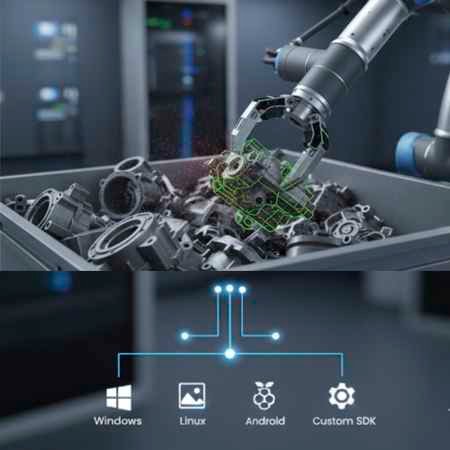
Solution: Active Stereo Vision delivers a complete, dense point cloud, accurately identifying the 3D pose (XYZ coordinates and rotation) of each object. High-speed USB 3.0 ensures fast recognition cycles, significantly boosting production line efficiency.
2. Case Study 2: High-Precision Industrial Inspection and Metrology
-
Challenge: 2D vision cannot measure critical 3D geometric properties like surface flatness, curvature, or volume.
-
Solution: The high-accuracy depth data rapidly generates an object’s 3D point cloud model. This model can be analyzed for sub-millimeter quality inspection and volume measurement, widely applicable in automotive, electronics manufacturing, and logistics.
3. Case Study 3: AGV/AMR Navigation and Obstacle Avoidance
-
Challenge: Mobile robots require real-time localization and safe navigation in complex, dynamic environments.
-
Solution: Wide-angle coverage combined with stable depth data provides reliable input for SLAM algorithms, enabling high-precision mapping and real-time obstacle avoidance for the safe and efficient operation of mobile robotics.
Conclusion and Call to Action: Start Your 3D Intelligence Journey
Choosing the right 3D sensor is paramount to the success of your machine vision project. The [Your Product Name] Depth Camera leverages the power of Active Stereo Vision, industrial-grade stability, and superior compatibility to offer you the shortcut to efficient, high-accuracy 3D intelligent applications.
Jiatel is dedicated to being your reliable 3D vision partner.
Take Action Today:
-
Experience the Ease of Development: Visit [Your Website Link] now to download the SDK and documentation and begin your 3D vision development.
-
Request Customization: For complex industrial requirements and advanced development needs, please contact our technical team for customized hardware and algorithm support.
Jiatel: Depth Drives Vision.
Share the Post:
Related Posts
🚀 Launch Your 3D Intelligence: Get Resources or Custom Solutions
Jiatel delivers high-precision, highly compatible machine vision solutions. Choose the next step that fits your current project stage.